A Thesis Submitted for the Degree of Doctor of Philosophy in Arts and Design
by
Fatima Aamir Kamal
Karachi, Pakistan
2025
Acknowledgement
This thesis is dedicated to my husband, Usman Pervaiz. I also wish to thank my parents, Aamir Kamal and Tahira Aamir, for always being there for me, and my precious children, Sophia Usman and Abraham Usman, who motivate me to pursue my PhD.
Abstract
This thesis focuses on figurative painting in oil within a traditional French setting, a context rich in cultural heritage that has deepened my understanding of French artistic traditions. I work in mixed media, combining oil paint and collage on canvas, wood and paper. I am also a furniture designer who specialises in coffee tables, and I therefore intend to design and produce a coffee table in the traditional French style, with an appropriate polish and finish.
I also intend to learn from French culture and heritage, and to consider how their approaches to infrastructure might be adapted for Pakistan or for household systems. As a product designer, I want to learn from the precision of French product and industrial design, and I plan not only to make the coffee table mentioned above but also to develop another product or system that could be introduced in Pakistan. Pakistan has recently faced serious difficulties with flooding, partly because there is no adequate drainage system to carry rainwater towards the lakes and the sea. A new system, or even a smaller household product, could help to address this need.
I will certainly be making visual art inspired by French culture during my residency, and I aim to create a fusion between that work and the work I produced at Arts, Letters and Numbers, which concentrated on organic, nature-based forms and figurative painting in oil on wood, canvas and paper.
“I intend to learn from French culture and heritage and how those solutions for their infrastructure can be applied in Pakistan or in household systems.”
Table of Contents
Chapter 1 – Introduction
I have been accepted, together with my husband, as an artist in residence at Château d’Orquevaux in France. We have been given the option of attending the residency in October, November or December 2025, or in February 2026. We are still deciding when to attend, depending on when sufficient funds become available.
I have always considered myself a feminist; however, having lived most of my life in Pakistan and part of it in Canada, I have often felt restricted in expressing myself as one. I deeply appreciate and respect French art and form, and it has long been my dream to travel to France. What could be better than travelling there for an art residency with my husband? I have been awarded the prestigious Denis Diderot Grant at Château d’Orquevaux, which is recognised as one of the ten most beautiful artist residencies in the world, although the grant does not cover the entire cost. I plan to infuse all the knowledge I gain at the residency into my PhD thesis in Arts and Design at Atlantic International University. My aim is to create a fusion between the figurative, nature-based work from my residency at Arts, Letters and Numbers (ALN) and the French-influenced work I intend to produce at Château d’Orquevaux.
It is possible that I may not have sufficient funds to travel to France in time for my thesis. I began my PhD on 30 August 2025, and at the time of writing it is the first week of September. I may therefore begin my thesis writing and visual artwork while conducting my research online, and within a few months I hope to have enough funds to travel to Château d’Orquevaux. Hoping for the best, I am very excited to begin writing my dissertation, as I have always loved French culture.
Chapter 2 – The Research Focus
My research examines French influence on painting, art and design. Both Impressionism and Cubism have their roots in France, and it was the French painter Claude Monet who launched the Impressionist movement. The French Revolution also transformed the world, including the world of art, and I intend to study its effects. As part of my practical research I produced a reproduction of Monet’s celebrated painting Impression, Sunrise, the work that gave Impressionism its name, and I then painted my own figurative work in the Impressionist style.
In researching the origins of Impressionism, I found that the movement takes its name from Monet’s Impression, Sunrise, an oil painting he completed in 1872 showing the harbour of his hometown, Le Havre, in Normandy. The painting was first exhibited in Paris in 1874 at an independent show that Monet organised with Pierre-Auguste Renoir, Edgar Degas and other artists as an alternative to the official, state-run Salon. A critic named Louis Leroy reacted scornfully to its loose, sketch-like handling and mockingly used the word impressionism to describe the new style; the artists soon adopted the label with pride. Rather than rendering the port in precise detail, Monet aimed to capture the fleeting effects of light, mist and reflection on the water, and this emphasis on sensation over exact description became the defining quality of the movement (Britannica; Musée Marmottan Monet).
Cubism, the other major movement I am studying, also developed in France, pioneered in Paris by Pablo Picasso and the French painter Georges Braque from around 1907 onwards. Instead of depicting a subject from a single fixed viewpoint, Cubist painters broke objects into geometric planes and showed several viewpoints at once, departing decisively from the tradition of realistic perspective. The French Revolution of 1789 reshaped art in a different way: as the power of the monarchy and aristocracy collapsed, the ornate, decorative Rococo style associated with the court gave way to the more austere and morally serious Neoclassical style, and art increasingly spoke to the public and the citizen rather than only to royal and aristocratic patrons.
I have begun researching French-style coffee tables and French coffee culture. The French tend to favour strong coffee, which can sometimes taste quite bitter, and it can be difficult to find coffee made in an authentically French style. I intend to learn from French culture and heritage and how those approaches to infrastructure can be adapted for Pakistan or for household systems.
My research into French coffee culture showed that it is closely tied to the history of the café as a social institution. The first café in Paris, Le Procope, opened in 1686, and over the following century cafés became gathering places for writers, artists and philosophers, as well as centres of political debate during the Enlightenment and the French Revolution. In the twentieth century, famous Left Bank cafés such as Café de Flore and Les Deux Magots were frequented by figures including Jean-Paul Sartre, Simone de Beauvoir and Pablo Picasso. The slightly bitter taste I noticed in French coffee is often attributed to a long-standing preference for robusta beans, which dates back to France’s colonial trade. For the French, the café is less about the coffee itself than about conversation, lingering and watching the world go by, and this is a quality I want to reflect in the design of my coffee table (Bean Poet; StoryLearning).
My research shows that the beret dates back several centuries and is widely identified as quintessentially French. It is worn in many military and other uniforms, and related flat caps, such as the Scottish bonnet, have developed elsewhere as markers of regional identity.
Looking more closely at its origins, I found that the beret as we know it actually comes from the Béarn region of the French Pyrenees, where shepherds had made felted wool caps to protect themselves from the cold and rain since at least the Middle Ages. It became closely associated with the neighbouring Basque people, which is why it is often called the Basque beret, even though the Basque Country straddles both France and Spain. Production became industrialised in the nineteenth century around the town of Oloron-Sainte-Marie, where the historic manufacturer Laulhère, founded in 1840, still makes berets today. The French army adopted the beret for elite units such as the Chasseurs Alpins in the late nineteenth century, and from there it spread to armies and special forces around the world. It was also embraced by artists and intellectuals — Picasso is often pictured wearing one — which is part of why it carries connotations of creativity. This rich history is what makes the beret such a meaningful starting point for the headgear I want to design for Pakistani women (Wikipedia; Laulhère).
Chapter 3 – Review and Other Work Done
This is my reproduction of a painting by Claude Monet. By making this reproduction, I studied the Impressionist painting style at first hand. I intend to paint portraits of my daughter and my son in the same style. Within my thesis, this painting relates to the course Contemporary Art and Exhibitions.

Figure 1. My reproduction of Claude Monet’s Impression, Sunrise, painted to study the Impressionist style.
This is some of the work I produced during my art residency at Arts, Letters and Numbers in Averill Park, New York, in the United States, which focused on figurative and organic forms. My research is a fusion of that nature-based work and the work for my PhD, which is influenced by French painting, furniture and the traditional French beret.
My course in Contemporary Art and Exhibitions connects to the paintings I have made for my PhD thesis and to the research I have conducted. My furniture design research and designs connect to the course Business Management for Creatives: I founded my business, Blends, and through it I have made furniture and paintings for exhibition and sale. As I promoted my products more actively, I began to generate more revenue. The headgear I have designed, inspired by the French beret, connects to the course Transforming the Business of Fashion, an online specialisation I completed through Coursera from Parsons. Below is a reproduction of Claude Monet’s Water Lilies; Monet painted many versions of this subject.

Figure 2. My reproduction of Claude Monet’s Water Lilies (the Japanese bridge), one of his many versions of the subject.
Chapter 4 – Research Methods
I intend to conduct my main research while I am in France for my art residency, although the dates of the residency are not yet confirmed. I plan to study the French system and way of life, and to consider what I can learn from it as a product designer. Through this research I hope to develop a product or system that could benefit Pakistan, or at least to introduce a useful household product.
I have started a journal in which I record all the information I gather, so that writing my dissertation will be easier and I will have enough material when it is time to submit. I have applied for grants to fund the trip to France with my husband for the residency at Château d’Orquevaux, though there is a possibility that I may not receive them. I will continue applying for further grants, since the residency directly supports my dissertation. I should add that, if necessary, my research on French culture and tradition may instead be carried out online.
I worked on natural, organic forms at Arts, Letters and Numbers and had many conversations with other artists at the residency. In high school I wrote my mini-thesis on Sadequin, a celebrated Pakistani artist, and at Arts, Letters and Numbers I produced a painting inspired by his work, which appears below in my research report. My own style of painting is a fusion of all these artists and the movements to which they belong.

Figure 3. A selection of my figurative and organic work from the Arts, Letters and Numbers residency, including the portrait inspired by Sadequin and the surrounding landscape.
I have been researching the beret and how it is recognised as a French cap that even artists wear to signal their creativity. It is also used in the uniforms of the police and army in many countries, including Pakistan. Drawing on this, I propose to design a headgear for Pakistani women that could serve as a marker of Pakistani identity. Since Pakistan was founded on the principles of Islam, this headgear would cover the head and face while leaving the eyes uncovered.
Chapter 5 – Results of Research Analysis
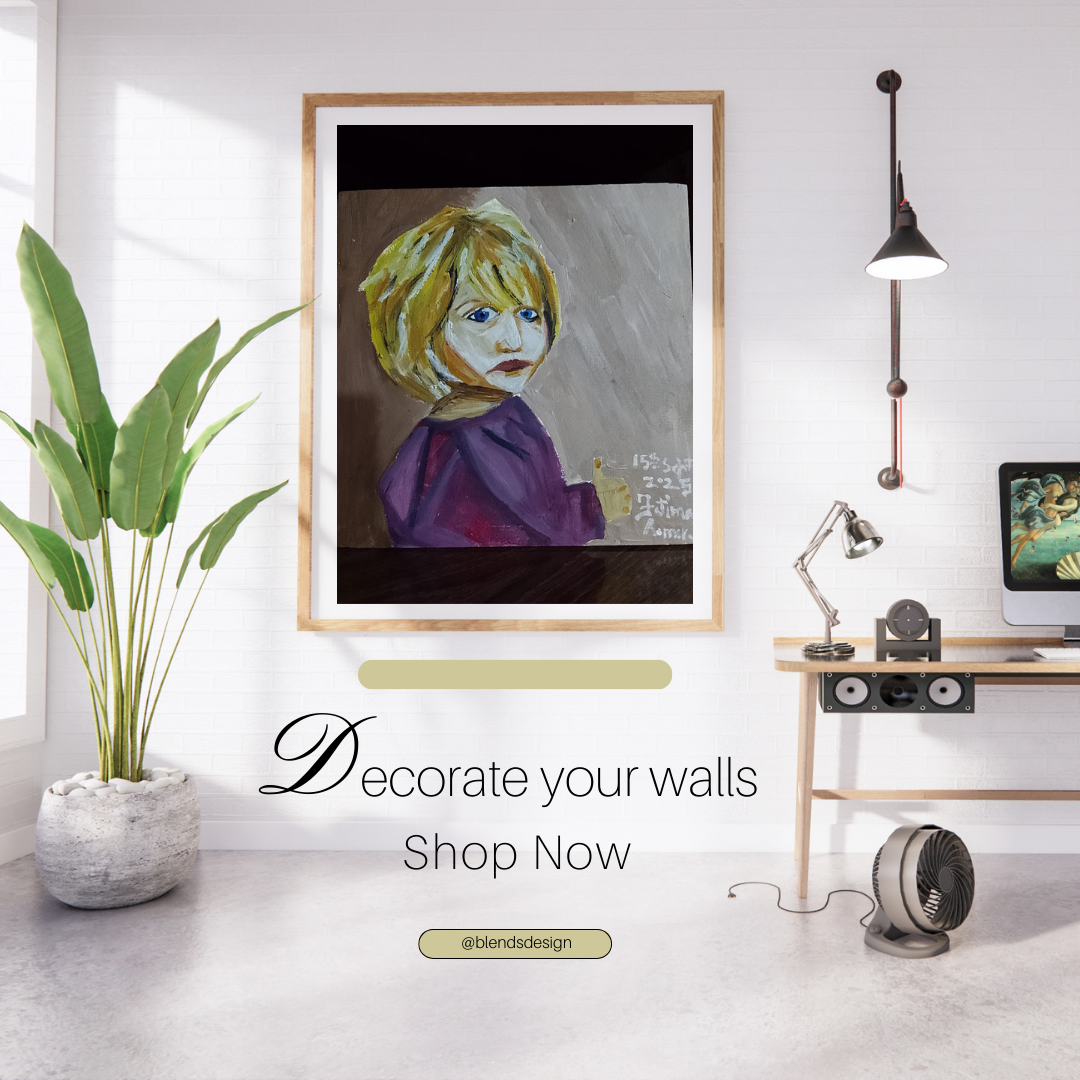
This is a portrait of my daughter that I painted in oil on canvas, in the Impressionist style I studied through Monet’s Impression, Sunrise. Monet founded the Impressionist movement in France. This painting relates to the course Contemporary Art and Exhibitions in Phase 2.

Figure 4. Portrait of my daughter in oil, painted in the Impressionist style, shown here as a Blends interior mock-up.
I have been researching French coffee culture and the traditional French style of coffee table, which typically involves carving, gold leafing and pale finishes. Drawing on this research, I have begun making sketches for a coffee table in the same spirit, though not an exact copy. I will have it built by a craftsman in Pakistan and include it in my thesis as a study of the French style of furniture.
In studying the French style of furniture more closely, I learned that the look I am drawing on belongs mainly to the eighteenth-century royal styles named after the French kings. Louis XV furniture, associated with the Rococo period, is characterised by curving lines, cabriole legs and delicate carved motifs of flowers and leaves, often finished with gilding. The later Louis XVI style turned towards Neoclassicism, with straighter, cleaner lines, tapered and fluted legs, and symmetrical ornament inspired by ancient Greece and Rome, while keeping the carved giltwood and gold-leaf detailing. The carving, gold leafing and pale finishes I want to use on my own coffee table draw directly on this tradition of French craftsmanship (1stDibs; Lorfords Antiques).
I have been researching the beret and how it is recognised as a French cap that even artists wear to signal their creativity; it is also used in the uniforms of the police and army in many countries, including Pakistan. I propose to design a headgear for Pakistani women that could serve as a marker of Pakistani identity. Since Pakistan was founded on the principles of Islam, this headgear would cover the head and face while leaving the eyes uncovered. I have made sketches of the headgear I intend to introduce to Pakistani women. It will be made from a breathable textile, and I will paint it myself to create the textile design.
Chapter 6 – Conclusions
This is the prototype of the headgear that I made: it is jersey material, hand-stitched and hand-painted by me. This headgear relates to the course Transforming the Business of Fashion. The image below shows the headgear on its own and the finished piece, stitched by a tailor and hand-painted by me to give it a fashionable edge for women in Pakistan to wear as a marker of identity and as protection from germs and from harassment in society. The headgear is inspired by the French beret, and it is something Pakistani women can wear to present themselves as Muslims who are forward-thinking and safe.

Figure 5. The beret-inspired headgear for Pakistani women: prototype versions and the hand-painted final piece.
A coffee table made in the French style, with a top of marine plywood and a base of partal wood, shown first before polishing and then with a pale, French-style finish. This coffee table relates to the course Business Management for Creatives in Phase 2.

Figure 7. The same coffee table after a pale, French-style finish.
A portrait of my son, Abraham, and a study of infant anatomy. This oil painting on canvas relates to the course Contemporary Art and Exhibitions in Phase 2. As things stand, I have not yet attended my art residency in France; instead, I have carried out my research online, studying French artists and culture.

Figure 8. Portrait of my son, Abraham, in oil; a study of infant anatomy.
Chapter 7 – Recommendations
I could also produce another reproduction of Claude Monet’s Water Lilies; Monet painted a whole series of these works and was one of the pioneers of the Impressionist movement. In addition, I have developed further colour options in which the headgear could be hand-painted, and I could make additional headgears finished in these colours.
All of these products — the paintings, the coffee table and the headgear — can be sold through Blends, the firm I founded in Karachi, Pakistan.
If I am able to attend my art residency in France, I will develop the French influence on my visual artwork and on my creative practice in product design much further.
References (Bibliography)
- Famous French Painters and Their Influence on Modern Art. https://www.lutece-langue.com/blog/famous-french-painters-influence-modern-art/
- French Paintings – Artst. https://www.artst.org/french-paintings/
- Iconic French Designers – Art Basel. https://www.artbasel.com/stories/iconic-french-designers
- 10 French Kitchen Must-haves – France With Véro. https://francewithvero.com/blog/french-kitchen/
- French Coffee Culture: The History, the Drinks, the Etiquette – Bean Poet. https://www.beanpoet.com/french-coffee-culture/
- Beret – Wikipedia. https://en.wikipedia.org/wiki/Beret
- Arts, Letters and Numbers. https://www.artslettersandnumbers.com/
- Best Artist Residency France – Château d’Orquevaux. https://www.chateauorquevaux.com/